
Someone else’s thinking
Part of the pleasure of watching a film is being surprised by someone else’s thinking. You’re deferring to their taste, their skill, their expertise, their storytelling. If you wrote and directed the film yourself, defined the story arc, you already know where it goes - no twist, no tension, no discovery. A lot of actors claim to never watch the films they’re in. Perhaps that’s why, or perhaps they just don’t like the sound of their own voice (I don’t mind mine). A joke you came up with doesn’t necessarily make you laugh, but there’s delight in stumbling across it, then crafting and sharing it. Sometimes repeatedly (just ask my friends who’ve all heard the same one at least 20 times).
What am I babbling about?!
People like to make original stuff to entertain others. And people like to be entertained by other people’s original stuff. Well hold the front page!
Twelve months in
This year I’ve had the pleasure of building a team in London, UK and Chengdu, China, east meets west creativity, different cultures with a shared vision. Working on what generative AI means for play. It has been without doubt the most creative, mentally stimulating and challenging year of my career.
We’re not interested in prompting our way to new versions of existing games. Anyone can do that. We’re interested in new ways to play. What is a generative play pattern? We’re diving deep into it. Unsurprisingly, stepping out of pure mobile play patterns excites me (despite a decade perfecting the art at Hutch, culminating in the $375m acquisition by MTG). At Hutch, we anticipated changes in play patterns from PC and Console to Mobile. We even helped create and steer some of these changes. That’s our aim with interactive generative video (IGV). We’re also interested in disrupting the status quo of the distribution rat race, but I’ll get into that another time…
Now that so much content is being made, what we’re doing is an even bigger challenge, and we’re having to rethink pretty much everything we’ve learned from the mobile gaming era. So much so that we don’t see ourselves as a games company, but a technology entertainment company.
We’re not forgetting where we came from, but bringing curiosity and impulsive, intuitive energy to something we still find quite hard to describe. Gamified video? Watchified gaming? Format discovery is the goal. The fact there’s no unified name for it yet shows we’re at the bleeding edge, right? You should see some of the stuff we’ve been creating. All in good time. Anyway, perhaps the best we’ve come up with thus far: Generative video, made playable.
Being in an extensive (and intensive) R&D play phase of the project, at the intersection of our curiosity, the ever-evolving tech coming out of our China AI lab, and shifting play patterns, has been both exciting and frankly overwhelming at times. But the seemingly endless incredible ideas that are emerging on a daily basis (some almost fully formed and playable before we’ve even blinked) continually validate my decision in choosing this path.
Layer cake: Music, film and games have all been here before
These three industries share a lot. Each has been through numerous stages of evolution, where a new layer emerges. As the layers come in and out of dominance, power and creativity are yanked back and forth between the people creating things and the people selling and distributing them.
Music went from live performance, to sheet music, to recording and radio, to the label era, to illegal downloading and iTunes, then streaming. Film went from silent film, to the studio system, to television, to blockbusters and VHS, DVD, Blu Ray, to downloads and streaming (legal and illegal). Games went from board games, to arcades, consoles and home computers, to Steam, and app stores, to Minecraft, Roblox and Fortnite, where the players became the makers.
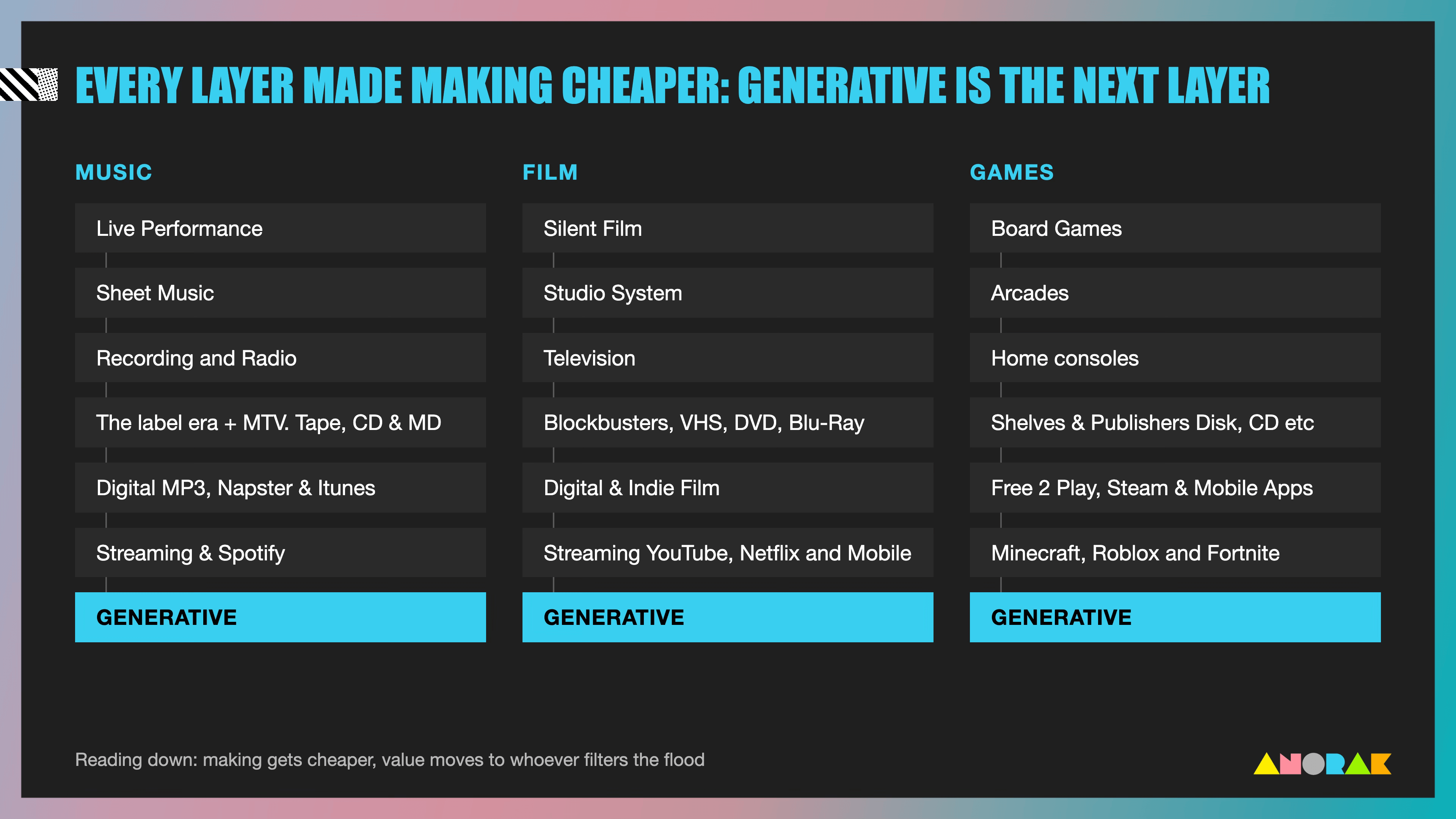
The pattern is the same every time. Making got cheaper and easier to distribute (though discoverability for distributors and creators got harder the more content was out there, be it games, music, film/TV), and value moved to whoever could filter the flood of content: the radio station, the A&R, the studio heads, the platform holders, the playlist curators. The taste makers. Scarcity went from the performer, to the recording, to attention, to taste making.
Generative is the next layer in all three industries, and it’s arguably bigger than the others, as virtually anyone has the power and the tools to create. Every previous layer changed how things were made or distributed, and the audience stayed the same: lots of people watching or playing the same thing. Generative breaks that. Content can be made by and for one person, on demand, and it can respond to them while they’re engaging.
I don’t for a second think everything will be exclusively generative (who wants to make a song that only they will ever hear? It would be like telling jokes you’ve written into a mirror. Which I’ve definitely never done..), but I believe it will certainly be a massive part of digital entertainment.
No one knows what the future holds, and I think we can all understand anxiety about job security in the creative industries. Jobs will undoubtedly change. There will be new jobs with names that have yet to be coined. And the previous layers will still be there, and have their audiences and proponents. But the more I’ve thought about it, and through what I’ve learned since undertaking this project, the clearer it is to me that tastemakers will continue to rule in entertainment. Whose taste? That’s the question. That’s where we could see a seismic shift. That’s the great unknown. Does it matter? My jokes may not make you laugh, but my friends find me funny.
Back to artisanal foundations
Abundance sends us back to the artisanal. Mass-produced beer gave us craft brewing. Streaming brought back vinyl. When people stopped buying physical music formats, live gigs became where musicians actually earned. Every time industrialisation made something cheap, a premium reappeared for the hand-crafted, the small batch, the artisanal - and with it, connection through its community.
So we will probably always want to be entertained by tastemakers - whether that’s a big publisher or a single person who has built a name for themselves. What they have in common is your trust. You go to a Pixar film, Supercell or Rockstar game for the same reason you go to your favourite local bakery: you believe someone with taste has made a choice on your behalf. The size of the maker matters not when it aligns to your taste.
Stories versus playgrounds
So why won’t we just make everything for ourselves, now that we can? Because of the problem I started with. If you define the path, there’s no surprise. We’ll always want someone else to tell us a story.
I believe the one place self-made does work is play. In a game you set the premise and the rules, but you don’t control the outcome. The system pushes back, and that’s where the delight comes from. Nobody gets bored of a game they designed the rules for, because if designed right it’s dynamic and surprising.
So the line, I think, is this: we won’t make stories for ourselves, but we can make playgrounds. We’ll keep paying tastemakers to tell us stories, and we’ll happily build and share our own worlds to play in. That’s why play is the format where “made for yourself” still has magic and why generative video is far more interesting as something playable than as just something to watch.
If you are the business, and your community the audience
Community means a lot to me, I’ve made WhatsApp groups called Padel Social, Sauna Social, What We Doing For Tea?, Quiet Drinks, Offensive Waste Channel (cannot recall what that one’s for to be honest) - I could go on. Purpose and a sense of belonging seems ever more needed in a fractured world. What if super-niche communities and subcultures could create playable generative video just for them? And it is monetisable. Original themes with authentic content, created by active communities not boardroom greenlight meetings.
Which raises the question our industries have never really had to answer. For a century businesses have been aligning what a business needs (to be viable) with what a market wants, at scale, with ballooning costs and risk. But what if you personally are the business, and your community however big or small is the audience? Can you make a living from that? Can you just make stuff for the pleasure of it?
It’s like going back to the cave and drawing noughts and crosses on the wall with chalk. Not because anyone will pay for it, but because the people around you will play.
What we’re building
At Anorak we’re working on play patterns and a platform to make any pursuit playable. It’s interactive generative video entertainment, not traditional mobile or video games. And it’s about anyone being able to create, according to their own taste.
Making stuff is easy now. Crafting something good still takes taste, and taste can take a lot of love and time to cultivate. But who are we to decide what good taste looks like?
Who will be the tastemakers of the future? We’re excited to find out. Will we be tastemakers at Anorak? The beauty of the platform we’re creating is that we can both create ourselves as well as enable others.
We will put our tech in their hands, giving them the tools to create unique nuanced play specifically for their subcultures. But who knows what will take off and become wildly popular outside of their primary audience? Think: DOTA a map made for Warcraft created an entirely new audience and play pattern.
I’ll share some weird and wonderful experiments in the coming weeks. We would love your feedback. In the meantime, here are our thoughts on AI slop.